
ECUST 2026 Outstanding Graduation Design Exhibition Opens at West Bund Art Center
Recently, the 2026 Outstanding Graduation Design Exhibition, hosted by the School of Art, Design and Media at ECUST, opened to the public at two venues: Building 9 of the West Bund Art Center in Xuhui District and Chengyuan Hall.
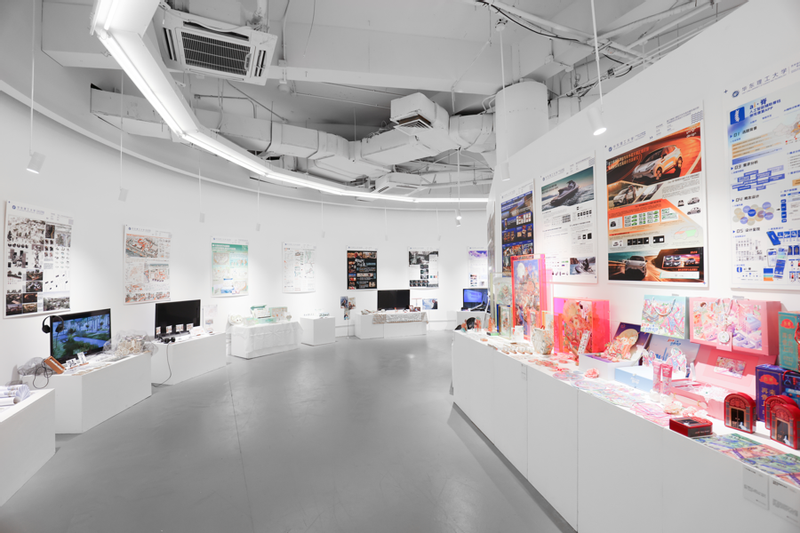
This marks the first time that graduation projects by ECUST students have been exhibited at the West Bund Art Center. The exhibition features a curated selection of 32 works centered around smart city, low-carbon manufacturing, digital intangible cultural heritage, embodied intelligence and human-centered design.
Spanning new energy vehicle designs aligned with industrial demands, revitalized IPs of time-honored brands, and smart solutions for urban spaces, cultural heritage preservation and home care services, the display embodies a shared creative ethos among young designers: forward-thinking innovation must not only advance smarter technology, but also enable technology to better understand and serve people.
The exhibition’s theme derives from a famous line by the ancient Chinese philosopher Zhuangzi: “Follow the rhythm of all things to free your mind.” It explores the relationship between humans and technology, and between humanity and innovation in the digital age. The phrase encourages us to work alongside tools rather than be dominated by them.
In the Low-Carbon Manufacturing and Smart City section, Jinhang Zhang, an industrial design student, used the SAIC MG Cyberster sports car and the MG4 family car as case studies to explore how new energy vehicles can sustain the brand’s sporty genes when shifting from flagship sports cars to daily household use scenarios. Rather than simply copying aggressive sports car aesthetics, he reinterpreted signature design elements, dramatic scissor doors, low-slung silhouettes and muscular wide rear fenders, into a design language suited for urban commutes, family trips and practical interior space. “People should be able to feel the thrill of a sports car in ordinary daily drives,” Zhang explained.
In the Human-Centered Design section, Jiaqi Gu, a visual communication design student, responded to young people’s emotional and lifestyle demands by reimagining White Rabbit Creamy Candy, a beloved local brand spanning multiple generations. Taking the iconic hopping rabbit logo as her core prototype, she transformed the 2D graphic into a 3D IP character set against the backdrop of Shanghai’s urban context. Four distinct rabbit personas were created: Cool Rabbit, Easy Rabbit, Run Rabbit and Chill Rabbit, each tailored to scenarios covering fashion, gourmet food, outdoor adventures and laid-back slow lifestyles. Her work evolved White Rabbit from a nostalgic childhood snack into a joyful companion for today’s young adults, illustrating the core design principle that all creative work should start with human experience and emotional resonance.
In the smart city section, students offered urban renewal plans covering EV charging, compact micro-transit and accessible public spaces. The Digital Intangible Cultural Heritage zone transforms oracle bone scripts, Liangzhu motifs and Chinese ink paintings into interactive contemporary expressions. Works in Embodied Intelligence & Human-Centered Design include smart emergency kits, elderly care gear, mood therapy tools and endangered plant displays. Many projects incorporate voice control, gesture sensing, haptics and generative AI for real-world use. Rather than showcasing tech for show, these designs simplify operation, improve public services, preserve culture and protect nature, making smart innovations that safeguard people’s safety, dignity, mental comfort and life quality.
This dual-venue exhibition links teaching spaces with public urban cultural venues through its on-campus and West Bund displays. It not only showcases the school’s distinctive educational achievements, but also highlights how young design students leverage their expertise to respond to contemporary social challenges and embrace the responsibility of building a better life through creative practice.