
New Progress in Conjugated Heterocycle Macrocycles for Photocatalytic Hydrogen Evolution from ECUST Published in CCS Chemistry
Recently, Professor Jianli Hua from the Feringa Nobel Prize Scientist Joint Research Center, School of Chemistry and Molecular Engineering, ECUST, in collaboration with Professor Andrew I. Cooper from the University of Liverpool, made a breakthrough in the development of conjugated heterocycle macrocycles for photocatalytic hydrogen evolution. The study, entitled “Conjugated Shape-Persistent Heterocycle Macrocycles for Sacrificial Photocatalytic Hydrogen Evolution,” was published in CCS Chemistry.
In this study, the researchers incorporated photoactive heterocyclic units, including benzimidazole, oxazole, and thiazole, into conjugated macrocyclic frameworks to construct a series of shape-persistent triangular conjugated heterocycle macrocycles. This molecular design enabled effective modulation of their electronic structures and light-harvesting properties. Compared with conventional imine-linked macrocycles, the heterocycle macrocycles exhibited a higher degree of structural symmetry, adopting C2-symmetric conformation.
Taking advantage of the excellent solution processability of these macrocycles, the researchers investigated their excited-state behaviors in both the molecular and aggregated states by combining time-dependent density functional theory (TD-DFT) calculations with transient absorption spectroscopy.
The results revealed that the heterocycle macrocycles possess more delocalized electronic distributions and longer excited-state lifetimes. Under photocatalytic conditions, long-lived electron polarons were observed in aggregates of the imidazole-based triangular macrocycle, indicating that intermolecular interactions facilitate charge delocalization and transport, thereby improving the efficiency of photogenerated charge separation.
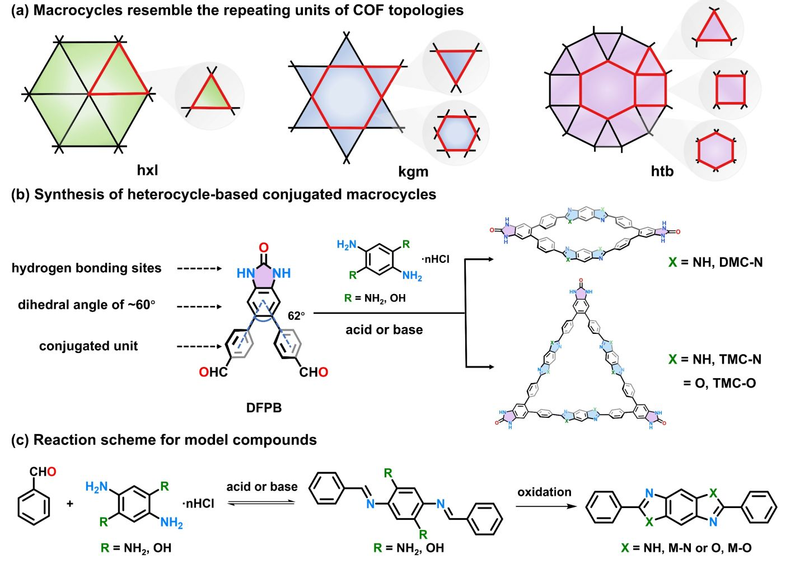
Benefiting from these structural and photophysical advantages, the protonated imidazole-based triangular macrocycle achieved a hydrogen evolution rate of 1390 μmol·g-1·h-1 under AM 1.5G irradiation (100 mW·cm-2), demonstrating its excellent photocatalytic hydrogen evolution performance and providing new insights into the molecular design of organic photocatalytic materials.
Overall, this study established a conjugated macrocyclic platform featuring high structural stability and tunability, elucidated how molecular symmetry governs excited-state dynamics and photocatalytic performance, and provided a new framework for understanding structure–property relationships in organic photocatalysts at the molecular level. The work also offered theoretical guidance and design strategies for developing next-generation organic photocatalytic materials with ordered architectures, efficient charge transport, and superior photocatalytic performance.
The research was primarily carried out by Dr. Xinman Liu from the School of Chemistry and Molecular Engineering, ECUST, Dr. Hang Qu from the University of Liverpool, and Dr. Chao Li from the Hong Kong University of Science and Technology. The corresponding authors are Professor Jianli Hua and Professor Weiwei Zhang from ECUST, together with Professor Andrew I. Cooper and Research Fellow Charlotte E. Boott from the University of Liverpool. The research was conducted under the guidance of Academician He Tian and was supported by the National Natural Science Foundation of China, the Shanghai Science and Technology Major Project, the Frontiers Science Center for Materiobiology and Dynamic Chemistry, the Feringa Nobel Prize Scientist Joint Research Center, and other funding programs.