
New Progress in Photocatalytic Nitrate-to-Ammonia Conversion via Dual-Quenching Charge Transfer from ECUST Published in Advanced Materials
Recently, Professor Jianli Hua, from the research team led by Academician He Tian at the School of Chemistry and Molecular Engineering, ECUST, has made advances in organic polymer-based photocatalytic nitrate reduction to ammonia. The relevant findings were published in Advanced Materials under the title “Dual-Quenching Charge Transfer Unlocks Record Nitrate-to-Ammonia Photocatalytic Conversion in Redox-Active Eosin Y”.
Rapid recombination of photogenerated charges and low efficiency of multi-electron transfer are core limiting factors restricting catalytic performance improvement in photocatalytic nitrate reduction. To address this issue, Professor Hua’s team introduced Eosin Y (EY) units with reversible redox activity into the conjugated polymer backbone and constructed a series of EY-based polymer photocatalysts.
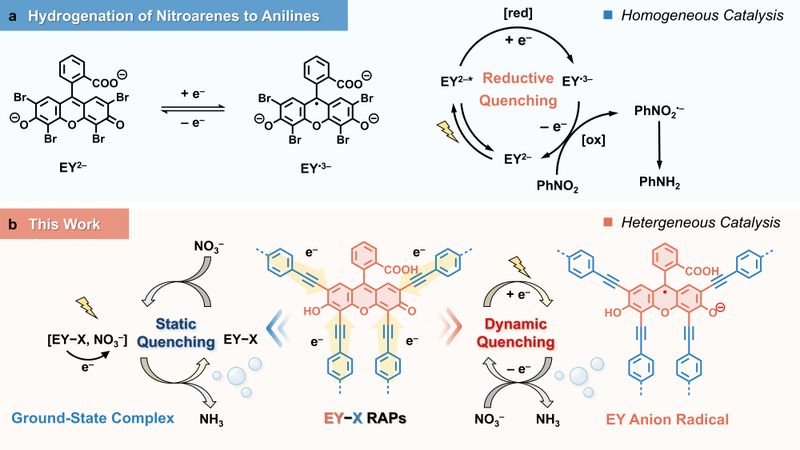
The study found that EY units can form long-lived radical anions (EY•⁻) under light irradiation, providing a sustained electron source for nitrate reduction. Meanwhile, the ground-state complex formed between the catalyst and nitrate ions enables substrate preorganization and promotes directional electron transfer. Together, these two processes establish a dual-path charge transfer mechanism integrating static quenching and dynamic quenching, which effectively enhances the separation and utilization of photogenerated charges. Enabled by this mechanism, the EY-BE photocatalyst achieves highly efficient photocatalytic nitrate-to-ammonia conversion. In the absence of co-catalysts, it delivers an ammonia production rate of 215 μmol g⁻¹ h⁻¹ with a selectivity of 93.6%, ranking among the best-performing pure organic polymer photocatalysts reported to date.
Jiayi Zhang and Dingming Chen, PhD candidates from ECUST, are the co-first authors of the paper. Professor Jianli Hua and Associate Research Fellow Min Zhou from ECUST, together with Professor Ke Hu from Tongji University, are the co-corresponding authors. This work was carried out under the guidance of Academician He Tian, and was supported by the National Natural Science Foundation of China, the Shanghai Science and Technology Major Project, the Frontiers Science Center for Material Biology and Dynamic Chemistry, and the Feringa Nobel Prize Scientist Joint Research Center.